

Cohort 1 half-year update: 21 independent newsrooms, three tiers of support, and progress ranging from first-ever digital platforms to audiences in the millions
JOHANNESBURG, 26 August 2026. Independent South African newsrooms backed by the Digital News Transformation Fund (DNTF) recorded measurable digital growth in the first half of 2026, according to the Fund’s half-year progress report covering January to June. Newsrooms that began the year with little or no digital presence launched first-ever websites and platforms, outlets that already had a digital foundation grew their audiences into the hundreds of thousands and beyond, and the Fund’s most digitally mature publishers began converting reach into new, non-grant revenue.
Cohort 1 backs 21 independent newsrooms through a tiered model matched to each outlet’s starting point: Build for newsrooms establishing a first digital foundation, Grow for outlets expanding an existing platform, and Engage for digitally mature publishers investing in new revenue models. Six months into the first cohort’s implementation, all three tiers are showing progress, each in the way the model was designed to produce.
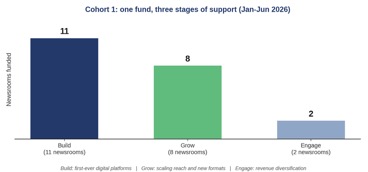
Figure 1: Cohort 1 grantees by funding tier, Round 1 (21 newsrooms, R10.5 million)
Build: from no digital presence to a first platform
The entry-level Build tier serves newsrooms with little or no existing digital footprint, several of them decades-old print titles serving township and rural readerships. Within six months of receiving funding, 10 of the Build tier’s 11 newsrooms had launched a first-ever website or digital platform. The Kokstad Advertiser in KwaZulu-Natal, a 144-year-old masthead, had no digital presence in January. Its monthly online reach peaked at 354,000 people in March, driven by its coverage of a missing seven-year-old girl that helped mobilise a community search and a formal police search-and-rescue deployment.
“The Kokstad Advertiser now has a digital presence where none existed before. We’ve gone from being accessible only to local print subscribers to reaching over 32,000 followers and up to 354,000 people a month across South Africa. In small towns like Kokstad, local news is at real risk of disappearing as print audiences shrink. This project has given us a viable digital future, and made sure trusted, hyperlocal journalism keeps reaching the Greater Kokstad community,” said Muhammad Luqman Jamal, DNTF Project Manager, The Kokstad Advertiser.
The Build tier collectively published more than 300 stories against a combined target of around 260, and on TikTok, Stokvel Media Hub grew from 344 to 5,945 followers in three months, the fastest platform growth recorded in the baseline assessment.
Grow: scaling reach that already existed
Grow-tier newsrooms generally entered DNTF with an existing digital presence and used the funding to expand it. Highveld Chronicle in Mpumalanga grew its Facebook reach by 233 percent, from around 300,000 to more than one million people a month, and extended its isiNdebele content onto regional radio reaching over a million listeners a week. Xenor Projects, which runs three community mastheads south of Johannesburg, reached a combined 1.7 million people digitally, in part through QR-code stickers placed in taxis so commuters could download each edition to their phones. Grocott’s Mail in the Eastern Cape grew its Facebook following from around 23,000 to 26,000 while sharpening its editorial focus around the stories readers actually engage with.
Engage: turning reach into revenue
The Fund’s Engage-tier newsrooms are its most digitally mature, and used the period to build on established audiences and begin diversifying income. explain.co.za grew its website audience from roughly 3,800 users in January to more than 60,000 by May, growth the outlet attributes to its editorial team coming fully into place mid-period, and now draws more than half its income from non-grant sources, including a reader-membership programme, a digital marketing division and video-monetisation partnerships.
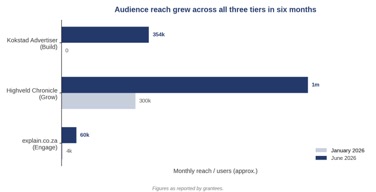
Figure 2: Reported audience reach, January vs June 2026, one outlet per tier. Figures as reported by grantees.
Reach translating into civic outcomes
In the Eastern Cape, Eagle Eye News investigated hiring and maladministration complaints at Burgersdorp Correctional Services. A community petition followed, and within three months Correctional Services began a renovation and infrastructure project that prioritised local youth employment. In the south of Johannesburg, Zini Advertising’s flood coverage reinforced official safety warnings during severe flooding in Lenasia South, and sparked community discussion about long-neglected drainage infrastructure. In KwaZulu-Natal, Inkundla Yezindaba’s “One Community, One Voice” campaign gave residents of the INK communities (Inanda, Ntuzuma, KwaMashu) a direct platform to raise development concerns with local decision-makers.
A voluntary Community Voice Survey of 87 readers, run alongside a separate baseline and organisational readiness assessment, points in the same direction. Seventy-five percent of respondents said they had taken part in some form of civic activity in the past six months, and 72 percent said local news coverage had directly prompted them to act. Seventy-one percent said they mostly or completely trusted their main news source.
| Cohort 1 at the six-month mark (January to June 2026) | ||
| 21 independent newsrooms funded | R10.5m in grant funding committed for the year | 9 of 9 provinces reached by grantee content |
| 300+ stories published by the Build tier | 65+ journalists and media staff trained | 10 of 11 Build outlets that launched a first-ever website |
Building on early momentum
The report is candid that converting audience growth into revenue, and informal newsrooms into governed organisations, takes longer than building a first platform. Financial sustainability, staff capacity and connectivity remain real constraints for small, community-rooted publishers, and compliance work, including POPIA-aligned privacy policies and basic financial systems, is a stated priority for the second half of the year. The Fund’s tiered model is designed around this: support is calibrated to where each newsroom starts, and progress is measured against that starting point rather than a single, uniform benchmark.
“These are early results, not the finish line. Community media is about being close to the people we serve — understanding their languages, challenges and the issues that matter to them. The first cohort is showing what becomes possible when community publishers have the resources to strengthen this work digitally, reach wider audiences and create stronger platforms for their communities to be heard,” said Anetta Mangxaba, DNTF Co-Chair.
AIP and Google, the Fund’s partners, shared the following reflections on Cohort 1’s progress to date:
“It is still early days but there are signs of green shoots. There is energy and innovation in this sector. I’m excited. The Fund is providing the spark to get projects going.” – Kate Skinner, AIP Executive Director.
“The digital milestones and audience growth achieved by these 21 newsrooms in just six months are highly encouraging. Seeing township, rural, and hyperlocal newsrooms successfully launch digital platforms and diversify their revenue is a powerful testament to the strength of this program. We look forward to seeing how their platforms and coverage will continue to grow in the months ahead.” – Marianne Erasmus, Google News Partnerships Lead: Middle East & Africa.
About the Fund and next steps
The Digital News Transformation Fund is a partnership between Google and the Association of Independent Publishers (AIP), administered by Tshikululu Social Investments. It supports the digital transformation of independent and community news publishers serving areas that mainstream media often overlooks, including township and rural newspapers, hyperlocal platforms and sector-specific outlets. Cohort 1 grouped 21 newsrooms into three tiers of support matched to each outlet’s starting capacity, backed by R10.5 million in grant funding for the year.
A full end-of-year report will follow in the first quarter of 2027, covering revenue diversification, governance maturity and audience retention. A second cohort of 22 publishers, backed by R15.8 million, is now onboarded, bringing the total to 43 independent newsrooms supported across the Fund’s first two rounds. Across those 43 grantees, 39 (90.7 percent) serve rural, township, peri-urban or informal settlement communities, and 28 (65.1 percent) publish in an African language, alone or alongside English.
For more information, please visit dntfund.org.za.
ENDS
Notes to editors
DNTF supports the digital transformation and sustainability of independent South African news publishers through tiered grant funding, paired with training, mentorship and structured reporting. The half-year report covers Cohort 1 for the period January to June 2026. Figures are as reported by grantees and reflect differing measurement periods. This release also draws on a baseline and organisational readiness assessment covering 14 of the 21 Cohort 1 grantees, and a voluntary Community Voice Survey of 87 respondents conducted alongside it. The full grantee record, including approved amounts, tiers and provinces, is published at dntfund.org.za/impact.
Media enquiries
Tuned Media | Tim Zunckel | Tim@tuned.co.za | +2771 600 4000
DNT Fund Communications | dntf@tshikululu.org.za | +27 11 544 0300
dntfund.org.za